Day 11: Reuniting with the Farmer, the Nursing Mother, and Java
Kamau:
“How are your daughters doing? How is the family,” I said. Kamau replied, “I only have one daughter now, the other has died. My mom died also. She was having trouble with the kidneys…I took her to many doctors.” “I am sorry to hear,” I sincerely replied. “It is just a part of life,” he responded.
Is life fair? Are you being rewarded for being a good person by having all these nice things we end up complaining about anyway? Is that why you were born into a country where it is inevitable that you will make a livable wage? Somehow, the “prosperity gospel” falls short when we reference real life. If you want to believe that you are of the deserved few because of your own goodness, go ahead, but you are wrong. There are no material benefits of kindness.
Do you make a lot of money simply because you work hard? Do you work 6am to 6pm seven days per week only to have no money because you are paying for your mother’s medical bills at suboptimal health facilities?
Am I saying not to be kind and not to work hard? No. As the farmer put it when I said, “You are a kind man, and you work hard to provide for your family.” He replied, “That is the way it should be.” If your purpose is not formed out of love, no amount of hard work or financial gain will replace the void of true happiness. True happiness is a product of character, grit, honor, and integrity. There are no short cuts to these values, and, in order to earn them, unlike your access to resources in this life, YOU are the one who has to put in the work for its just attribution.
Job says in the Bible, “When God sends us something good, we welcome it. How can we complain when He sends us trouble?”
After Kamau kindly asked to return back to his work, he said, “You remembered me all this time?” I said, “Yes, of course.” He said, “I must request a big hug.” The embrace lasted some time. Then, he said, “I am so happy. Now, I must return to my chores.”
African Jesus:
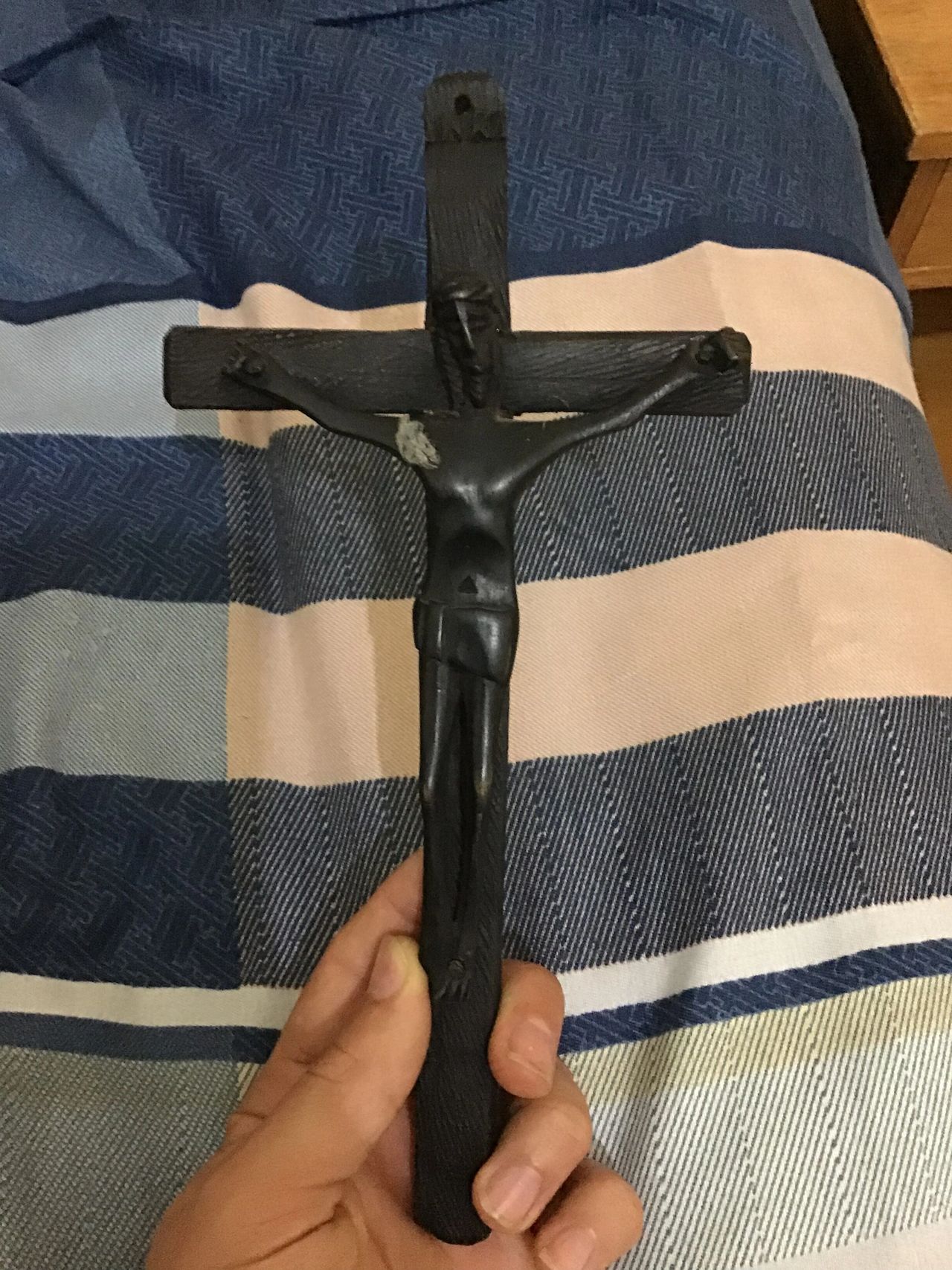
At 11 am, we went into town to get some last few appreciation gifts. In the city, I was looking for an African Jesus. As interesting as it is, nearly every depiction of Jesus in Kenya is Caucasian. As we were walking the streets, a hustler told us that he had an African Jesus in his shop. Sure enough, he did, but there was quite a hustle at play to get it for a good price. The hustlers spent time trying to disorient and distract me by offering other items and telling me to touch the items and pretending to share commonalities in birthplace (Ohio), etc.
When they finally gave into to starting a bargain, they had a a small African Jesus on the cross, a large African Jesus on the cross, an oil painting of a Maasai village, and a zebra pattern fabric. The main hustler even claimed that he got the kids off of the street who were sniffing glue by taking them to the YMCA and teaching them how to paint. They kept talking out loud to each other, saying, “This one is a good one, make sure to give him a good price.” “Yes, I know, I am giving him a good price.” They all came with chairs to sit me down and disorient me. They came up with 27500 KSH ($275). I told them, “My best offer is $10 for the small Jesus.” They kept insisting, “No, you do not say your price, you write your price.” Everytime, I wrote 1000 KSH ($10), and they would say, “No, you see, we are coming down in price, you have to meet us somewhere in the middle.” I said, “It seems our prices are too far apart to make a deal, I will look somewhere else.” We finally bargained to 1000 KSH ($10) for the item I have been searching the last couple of trips.
Camel’s Milk:
We then ventured on for lunch where Wachira ordered me the camel’s milk that I had been requesting. I would not say that it was delicious, having a charcoal flavor and a less creamy composition than whole cow’s milk, but the 24 oz. that I drank of it did not bother my stomach, which is always good news when trying new things. To top things off, the cost was only 120 KSH! The meals were very big and for a very inexpensive cost. I received a full plate of curry chicken with rice for only 650 KSH. Washira’s 600 KSH plate of fried goat meat and seasoned rice was enough for a family, and fateful enough that they were. As we had seen homeless sitting along the walkway of the streets coming from the car, I asked if we could get a “doggy bag” and give our food to someone along the way.
The Nursing Mother:
Wachira and Laurie were okay with the plan, so we carried out left-overs and along the way, there was a nursing mother. She looked to be exhausted past the point of proper bodily functioning. The baby seemed to suckle at a well that was run dry. As I places a box of the food next to her, she barely could mouth “Asante,” her eyes half-open. A man said, “That is a nice thing you are doing.” I walked forward to catch up with Wachira and Laurie when Wachira said, “Why not give her both, and the bag she can use for something?” I am very glad by his suggestion because I spent the rest of the day thinking about this woman and her child. Who among us can be more deserving of love and care than this mother who is dying in the streets and with her child in her arms? Nairobi is one place where you see people approaching death in the public streets as the cost of living is high and the opportunities for the people to have ample income are relatively low.
National Game Park:
We ventured on to the National Park in Nairobi where Wachira drove us through. It is the only National Park within a capitol city in the world. Unfortunately, due to the rain, the grasses were much too high to see many of the animals that lurk amongst the grasses. We saw many birds (including kiwis and ostriches), antelopes, warthogs, giraffes, hippos, a chameleon, and, on the way out, monkeys.
Kamau Visits Java:
Arriving back at the Mary Ward Centre, I asked Wachira and Laurie if we could host Kamau to Java, since he had never been. In fact, last time I was in Kenya, when I was doing farm chores with Kamau, he said, “I cannot go. They will think that I am stealing if I go there.” I looked for him at the farm and could not find him. I then asked one of the staff if he lived on campus at the Mary Ward Centre, and she led me to him. We found him, just outside his room coming in from the long, arduous process of being the one farmer for the whole campus. I told him that we could go to Java now since our flights were leaving tomorrow evening, and we may not find another time since hid daily chores are so many. He said, “So I need to go with you now?” I said, “Yes, if you want to go to Java.”
After he changed in his room, we walked over to the car. He grabbed me gently by the hand to hold hands as we walked. In Kenya, it is more common for adults of the same gender to hold hands as a sign of friendship. Shamefully, this was embarrassing for me, and the whole time, though being gentle myself, I was searching for an excuse to let go. Before arriving at the car, he let go and said that he would meet us at the gate as he had to inform security of why he would be leaving.
On the car ride, he reminded me of a nervous boy leaving home without his family for the first time. His body language made him appear small as we sat in the back seat. We exchanged conversation, and he expressed his wonder in the opportunity to eat somewhere where he had been excluded all his life. As we walked into the restaurant, he seemed to hide behind me as it appeared he did not want others to see him and look down upon him.
Once seated, he expressed his gratitude again, saying, “I will never have taken such a thing as this.” With a menu handy, he seemed overwhelmed and turned to me to say, “I want to have what you are taking.” I ordered us a decaf vanilla capacinno with soy milk and chicken curry with rice and salsa; the only alteration for his meal being that his vanilla capuccino was caffeinated and with cow’s milk. As we sat, he seemed to relax a bit, and we all talked about our lives, sharing about the amazing powers of camel’s milk that I had experienced earlier in the day.
When our meals came, he expressed his delight in the coffee and the food multiple times, saying, “This has a nice taste…Yes, this one is very nice…I never have taken this one.” As the meal ended, we went to the car and shared more stories of life and stories of my teaching and the differences in my students. Kamau said, “The more work, the more wise they become.” I told him that I would tell my students in the US that they should not complain for homework because it is making them wise. Surely Kamau’s wisdom is a testament to the formative nature of hard work. When you work only get an afternoon for rest once per week, serving 6 am to 6 pm, complaining can give you nothing but more work to do later.
Kindness:
Dropping Kamau off, he again thanked me and said, “You are the kindest person that I have ever met,” gave me a big hug, and we parted ways. It is only that, I am not the kindest person that he has ever met. I have met so many more, especially Davis and Sharon who impoverish themselves to care for others. Davis had told me a story when we were in the slums last week about how they were so excited to give out chicken to the families in the slums, but when they returned home, they had given until there was none left for their own family. Davis and Sharon live by the grace of God, living as donations come from generous others in order to run the program. Nothing is a gaurantee from month to month, giving a great majority of their resources to others in the community. And yet, Davis and Sharon do this with such great joy and kindness, trusting on God to provide.